At least nine detained Aligarh Muslim University students were released Monday night at around 8 pm following pressure from local Aligarh residents, who gathered on the streets near the university to protest the students’ detention.
Syed Zamin Mehdi (18)’s older brother, Syed Mohammad Mehdi was one of the students who was detained by the police and rapid action force (RAF) on Sunday night during protests. He was released at 8.30 pm from Civil Lines Police Station yesterday after being pressured to do so by local Aligarh residents. The police beat Mehdi up who suffered head injuries and had to get 5 stitches. He is now on his way home.
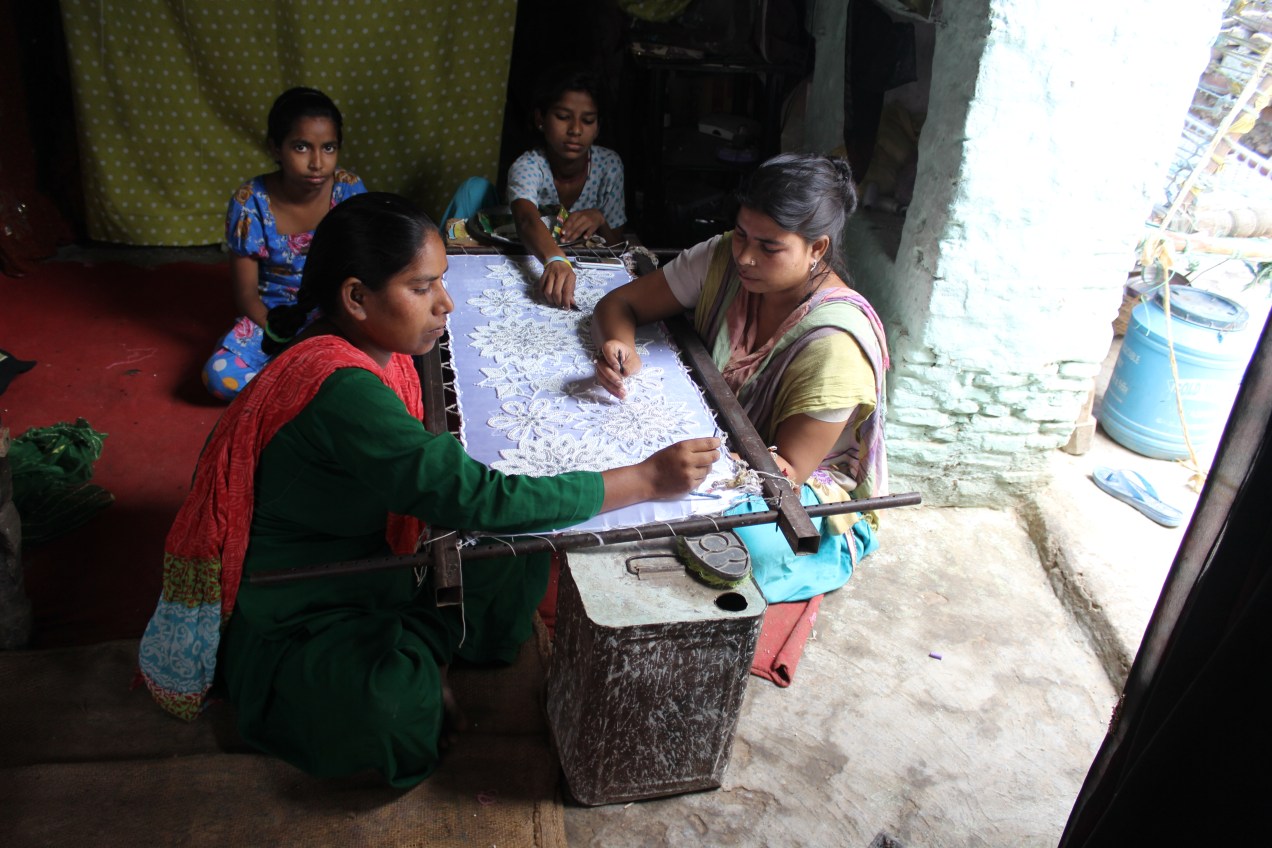
Rifat Bano sits on the brick floor of her home in Marehra chatting with her sisters. Between them lies a snow-white satin cloth stretched tautly on a rectangular wooden frame.
Over a hundred shops belonging to small traders and even some homes have been demolished in Aligarh with little prior warning and no compensation, as smart city protocols were initiated in the city with zero or minimal planning.
Prime Minister Narendra Modi, in his campaign speech in Aligarh on April 14th, invoked three main development indicators, “bijli…kanoon vyavastha…sadak” (electricity, law and order and roads)**.” Development or “vikas” has been one of two constants in his campaign; the other being “karobaar ” or business. In his Aligarh speech, he specifically mentioned how this election was a fight to get “nyay” not only for youth, women and farmers but also for “chote karobaari” or small business owners.
Yet, in Aligarh, vikas and chote karobaari clashed head on when shops belonging to small business owners were demolished to widen roads as part of the Smart Cities Mission.
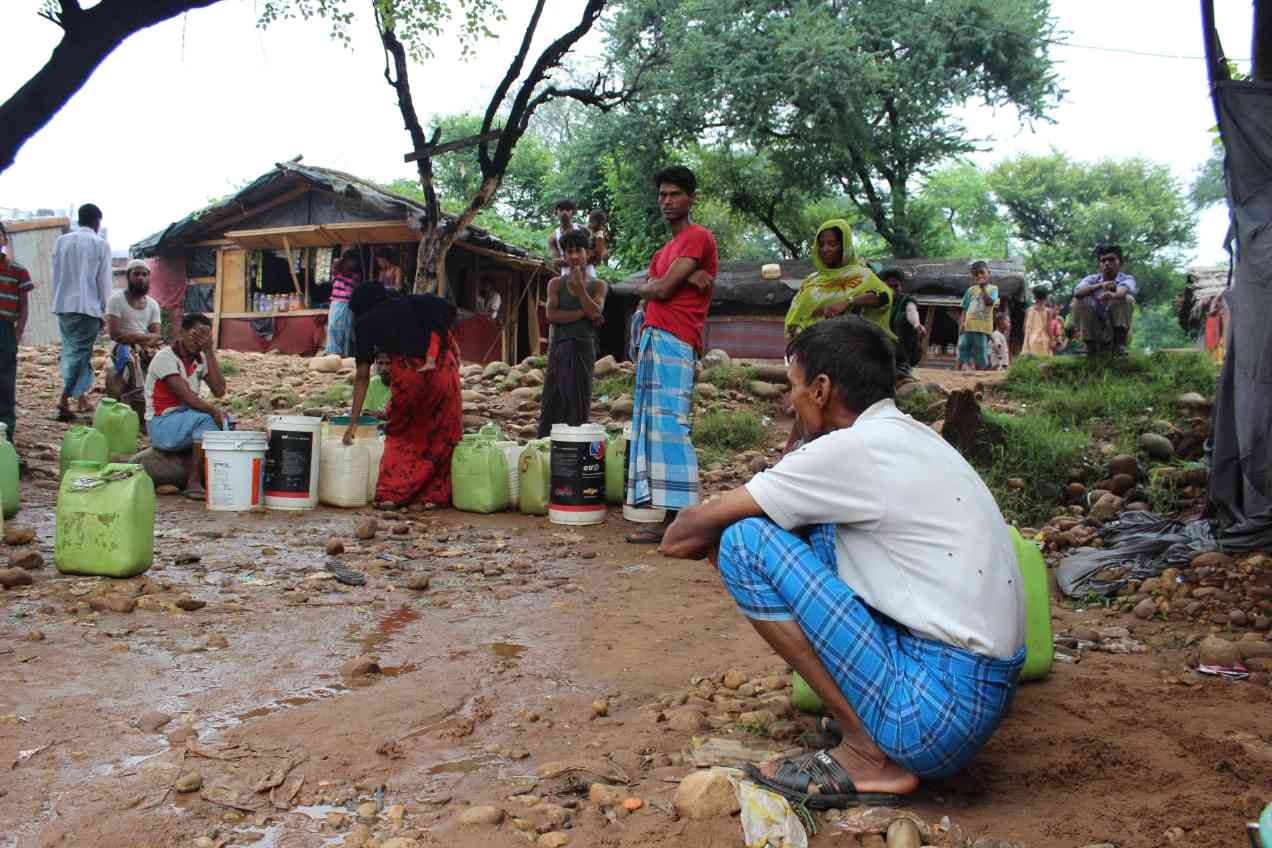
Rohingya refugees left Aligarh after demonetization but are now returning because of unsafe living conditions in bigger Indian cities.
Aligarh:-– Guran Miya (30), a Rohingya refugee, returned with his family to Aligarh in mid-2018, just nine months after he had left.
During this time, he lived in Bangalore and then Hyderabad. It was a struggle, especially in Hyderabad, where he lived in a refugee camp. He says that people had to get in line to use the toilet and there was also a lack of privacy, especially for his wife, when she went to take a bath.
Though he lived rent-free in both the cities, he says that he prefers to pay Rs 1200 per month for a room that he rents in Aligarh.
“Wahaan izzat nahi hai,” (There was no sense of dignity living there), he says.
Seeking to reassure fellow refugees, Rohingya community leaders found themselves negotiating with the state over a data-gathering exercise last December.
A good community leader, says Mohammad Zafar (24), should have three qualities: ” Thanda dimagh, padhai-likhai, aur aadmi se nafrat nahi honee chahiye (He should have a cool head, be educated, and have no hatred toward anyone).” Zafar is a Rohingya refugee and a leader, or zimmedaar, of the Rohingya community in Aligarh.
Zafar is a Rohingya refugee and a leader, or zimmedaar, of the Rohingya community in Aligarh.
In November last year, just a month after Zafar was elected zimmedaar, officers from the local unit of the CID landed up at the community centre built by Rohingyas. According to a person present at the meeting, the CID men told the refugees gathered there that they would need to fill out a set of forms, or else their stay in India would be “beqanooni”, illegal, and the government could then do whatever it wanted with them.
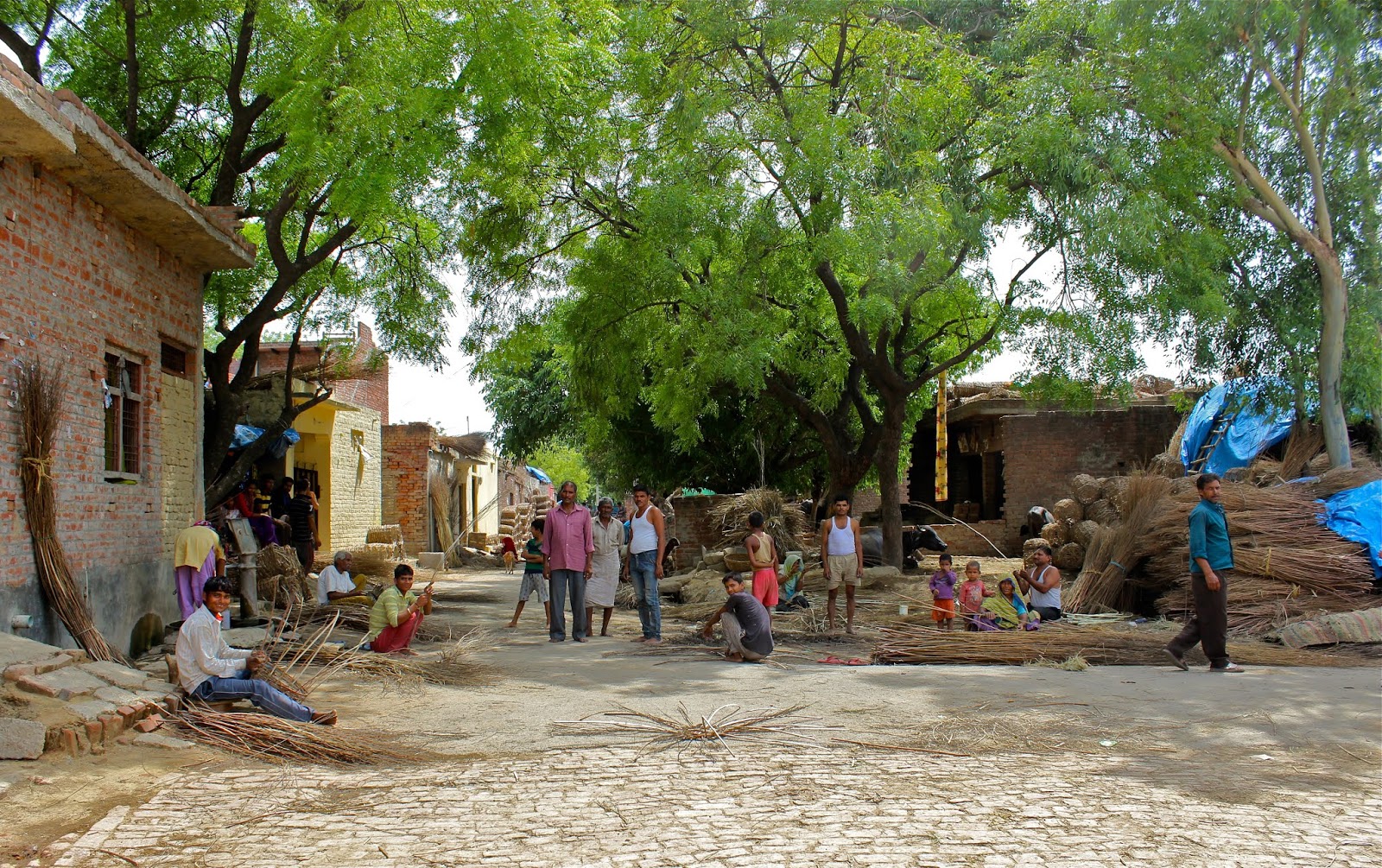
Mahmoodpur Nagariya is a village of basket weavers.
It is located ten kilometres from Marehra, in Etah district of western Uttar Pradesh.
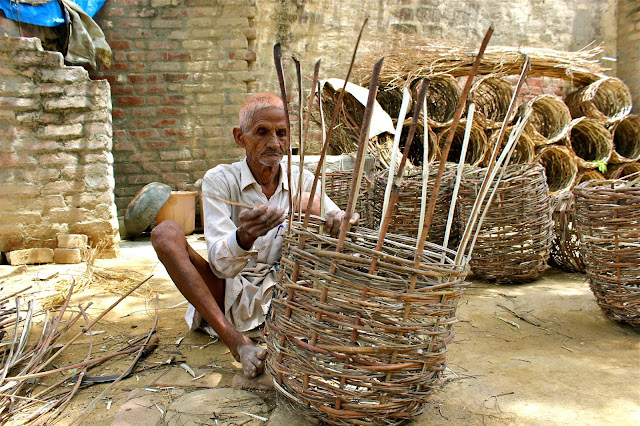
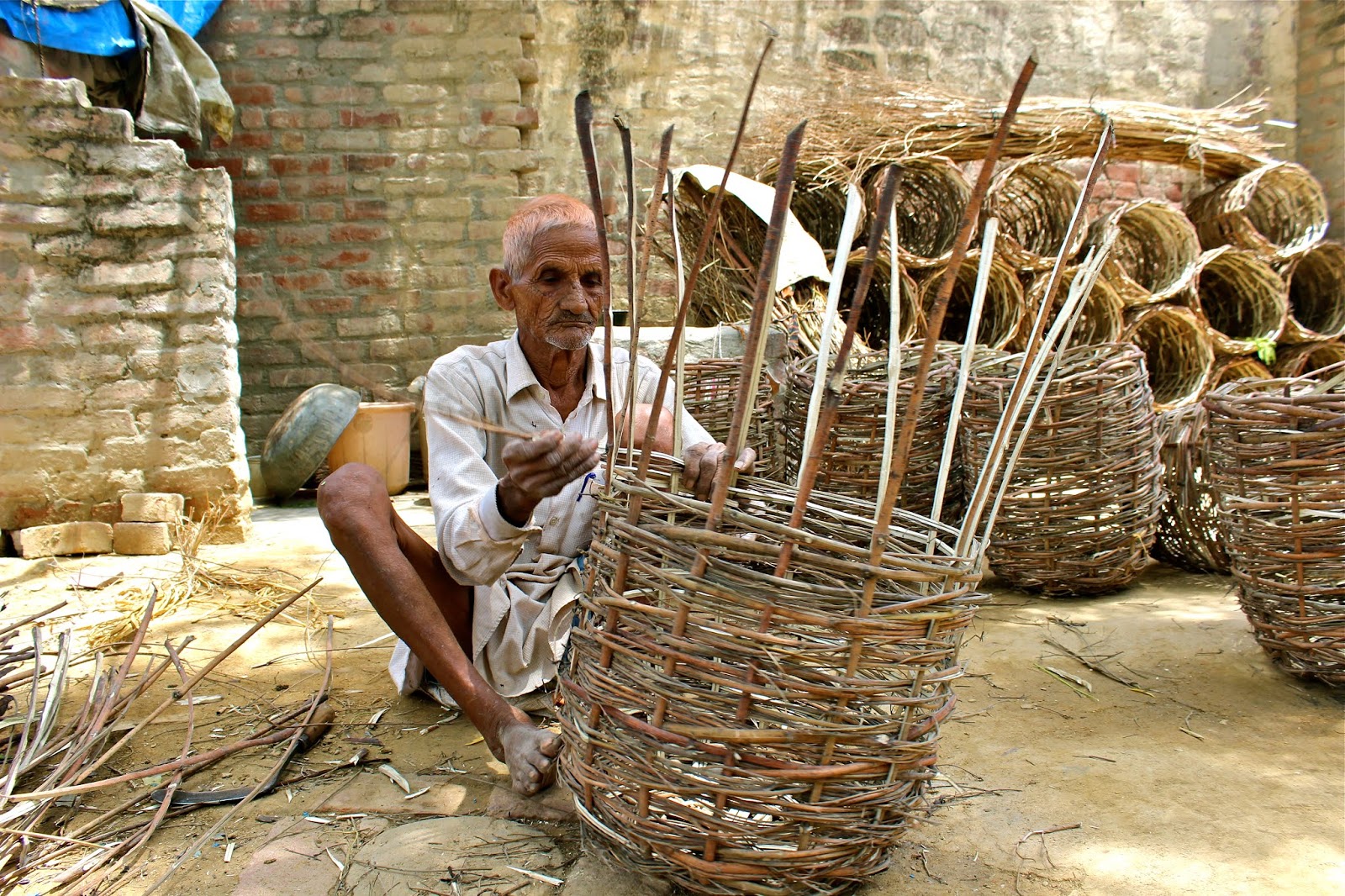
Nem Singh is about 80 years old and among the oldest weavers in the village.
He sits on the mud floor of his aanganor courtyard, in the mid-morning heat of June, under the shade of a neem tree, weaving wooden baskets.
In dehati or village parlance, the weaving process is known as bardana.
Nem Singh first lays down fifteen vine-like strips of wood on the ground, four to five a pair, arranged at a thirty-degree angle from each other.
He sits at the centre of this arrangement, takes one of the fifteen strips and weaves it, in a circular fashion, into the rest of the strips laid out on the ground.
As he weaves, so he turns, as if he was weaving himself into the basket.
Once the base is ready, he “climbs out” and holds the base at chest level and the pointed strips away from him.
A weaver has to be careful not to let these injure his eyes while he weaves, he cautions.
He now starts on the “wall” of the basket, taking more wooden strips and weaving these upwards, from the base of the basket.
When asked how he knows the exact point at which to make the wood turn so as to give the basket a circular shape, he responds: “Yeh, yeh haath batatein hain (This, the hands tell me).”Nem Singh weaves a basket in his courtyard.
Nem Singh turns the basket once more, this time using a hasiya or sickle, his only tool, to trim away splinters.
The finished basket is called “pittoo” and is used to store and transport mangoes.
Bonded Labour
Nem Singh learned to weave as a child from his father and the elders of his village.
All those who weave these baskets belong to the Jatav caste and identify as Dalits.
Before independence, they used to work as bonded labourers for the upper-caste zamindars of this village.
Nem Singh recalls: “Jabran aisa hota hai ki ‘Chalna padega, ye kaam hamara hai. Mata chauki jao, chalna padega aapko, kaam karna hain.’”
“Forced work is like [the zamindar saying to you]: ‘You have to come, this is our work that you are doing. Pay your obeisance to us. You have to come, you have work to do.’” Nem Singh with the baskets he has woven in the background.
He was seven when he became a bonded labourer.
“Hamare bade-budhe karo phir humko lagvaya tha, phir humko chara roz diya karte. Humko jo … sab cheez bantee, yani ye bajra katno, kheti-hari karnee … teen kilometre yahee cheez thee.”
“First our elders worked as bonded labourers, then they got me to work as well. Then, I would get grain everyday. We had to do everything, cut the millet crop, clear the grass … for three kilometres this is what there was.”
What he remembers most from that time is his community’s lack of access to drinking water.
“Hamare saamne jo hai, humko paani tak peeno nahin mila, paani wahan se, ek kothee vala kuaan us pe se hamaree pilaa te … humko paanee thaa hee nahin gaon ke andar.”
“In my time what I saw was that we didn’t even get water to drink. We had to get water from a well near an old house (on the outskirts) … there was, in fact, no water available to us inside the village.”
The zamindars refused to allow them to dig a well for themselves and only when the Thakurs bought the land were they allowed to do so.
Landless economy
Lohia-Rajputs, listed under Other Backward Castes, are the largest community in Mahmoodpur Nagariya, with 300 households, says resident Vijendra Singh who is Vice-Principal at Veeragna Avanti Bai School in Marehra.
The Jatavs are the second-largest community with about 150 households.
The majority of them are landless.
This means that though their district falls in the fertile tract between the Yamuna and Ganga rivers, known as the Yamuna-Ganga Doab, their economy has always been dependent on those who own the land.
Basket weaving continues throughout the day in the village of Mahmoodpur Nagariya. (Corner right) The brittle arhar branches that weavers turn into baskets are stacked in courtyards and covered with blue tarpaulin to keep them dry at night.
In the mid-1960s, when cauliflower was not as widely cultivated as it is today, it was farmers from Mahmoodpur Nagariya and surrounding villages who grew it and sold the surplus to traders from Aligarh, Kasganj, Farrukhabad, and even Calcutta.
It was the last group of traders that trained the Jatavs to weave these baskets so that they could safely transport their produce all the way to Calcutta.
This, says Nem Singh, is how the craft was introduced in his village and others.
Villagers used the wood of arhar trees to weave the baskets.
This is the same tree that gives us arhar ki daal or split red gram.
It grows in arid regions but could be found in the poorly irrigated fields of Mahmoodpur Nagariya and its surrounding villages, says Nem Singh.
But as the landowners improved their irrigation methods, arhar ceased growing there and the Jatavs had to look elsewhere.
That elsewhere turned out to be two hundred kilometres away in villages of Auraiya and Jalaun districts.
They have been travelling there for fifteen years.
A single trip costs them no less than Rs 32,000 and they make at least two between March and June, when the mango season is at its peak.
The rent for the truck alone costs about Rs 9,000 and it can carry only 500 bundles of arhar.
To make it affordable, about four to five families chip in and the mango cultivators, their primary buyers, also give them an advance.
Mangoes
Although the region of Awadh, with Lucknow as its centre, is the most famous for its mangoes, the districts of central Doab rank among the highest in mango production.
And it is mangoes that sustain the local basket weaving economy of Mahmoodpur Nagariya.
During mango season, it seems as though the entire village has spilled out into their aangans.
Devendra Singh (40), another weaver, says that he knows of no other village except his own and the neighbouring village of Mohan Sati, where the craft is practised by the entire Jatav community.
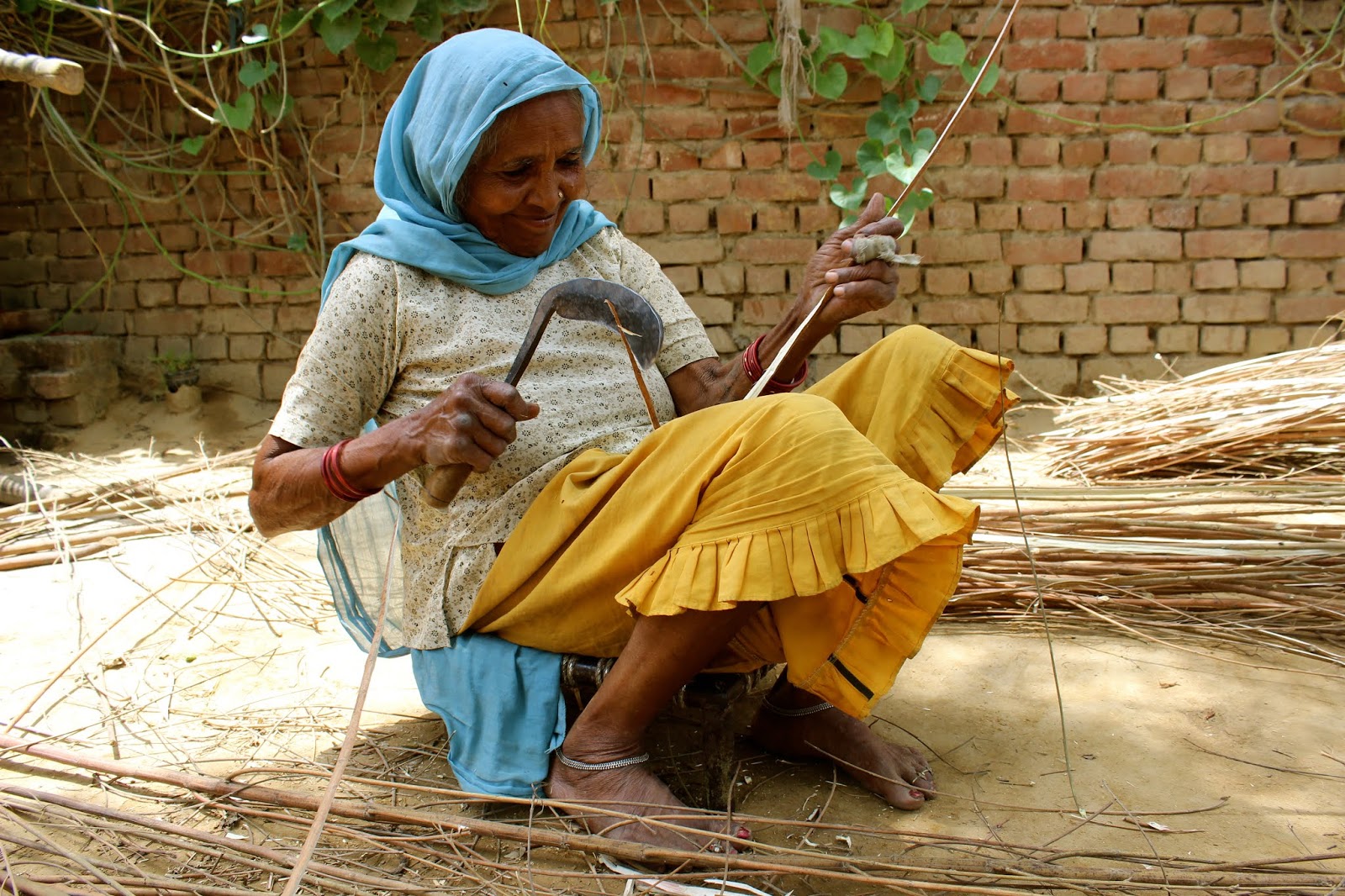
The women split the wood while the men do the weaving.
Ayudhya Devi is Nem Singh’s wife.
As he weaves, she sits across from him, upright and without any back support, a brambly five-foot-tall arhar stem locked between her knees.
Ayudhya Devi splits an arhar branch into two. Both the prepping of the wood and the weaving is done in courtyards or sitting outside the homes.
With her bare hands she tears down its middle using a sickle where the base is thicker.
She has been splitting wood ever since she came to this village as an eleven-year-old bride. She is now over 75 years old.
“Budhaape mein kachu kaam nahin hota (Old age does not allow me to do much work),” she says.
After splitting wood, she cooks dinner.
The arhar pieces are soaked overnight in a village pond, which softens the wood and makes it pliable.
Weaving begins the following morning.
Nem Singh is able to weave about fifteen baskets a day, although he says that when he was younger, he could weave twice that much.
As the baskets get completed, they are loaded onto tractors and sent to buyers in Aligarh, Khurja, Bulandshahr, Kanpur and Sikandra Rao. From there, they travel as far south as Mumbai, filled with mangoes.
Profit and loss
The weavers sell their product for Rs 25 a piece, earning a profit of around Rs 12 per basket.
At the end of the month, Nem Singh’s savings amount to Rs 1142. This includes the pension he receives under the Indira Gandhi Old Age Pension Scheme.
He says: “Aisa hain ki ab ismein humko majoori padh jayegi tab tak to hum kaam karenge, majoori nahin padegi hamare liye to hum nahin karenge ise. (The thing is that we will do this work until we can earn an income out of it, if we cannot, then we will not do it.)”
His income and that of other weavers takes a hit with the end of the mango season.
Without land, the Jatavs cannot turn to farming to earn a living.
As a result, most migrate out of the village. One such weaver is Man Singh (47), who goes to Delhi along with his two sons. He works there as a painter, an occupation that is favoured by most Jatavs who migrate from the village to the capital, he says.
Nem Singh, however, is too old to migrate. He farms his own two bighasof land on which he grows corn, wheat, and peas for his personal consumption.
He also works as a farmhand in the fields belonging to the Lohia-Rajputs.
From July of this year until March of next year, Nem Singh will clean their fields, now planted with corn, of grass and weeds.
He will also continue to weave baskets, although these will be smaller in size as they are used to store vegetables. Their sale will depend on the quantity of produce that needs to be transported. It will neither be fixed nor as profitable as the sale of mango baskets.
Before this photo was taken, a few men loaded these baskets onto the truck and secured them with string. This truck will transport the baskets to various mango orchards in the region, where they will be used to store mangoes in bulk.
This essay focuses on qissas or anecdotes of small incidents that make up everyday life in small towns in India. These can be seen as alternative histories of a place, removed from official census and surveys that categorize communities and are preoccupied with accuracy of facts. It uses both image and text to tell the story.
The government is unable to deport them to Myanmar and unwilling to allow them to stay, thus condemning Rohingya refugees to endless and arbitrary detention. An investigation
Jammu: I met Abu Alam in Jammu on a Friday afternoon in August this year. A Rohingya Muslim from Maungdaw Township in Myanmar’s Rakhine State, Alam fled the country in 2010 – two years before sectarian attacks on the minority community by radical Buddhist groups led to a flood of Rohingyas seeking refuge across South and Southeast Asia.
He made his way to Jammu but was arrested for entering India illegally and without a passport. He was jailed along with two other Rohingyas, Mohammad Salim (20) and Mohammad Farooq (19).
Alam says he is now 20-years old, which means he would have been 15 at the time of his arrest.
A haveli that has weathered 200 years in Ahmedabad’s old city and the man who fights to keep it standing have found the last two decades the most trying yet
“Do you know Guruji? Madhavrao Sadashivrao Golwalkar?” asks Duttatrey Vyas, sitting in his living room that was once used to store grains. “He visited this house. As did Narendra Modi, when he was an RSS worker.”
Vyas is referring to the 200-year-old haveli his family has lived in since 1942. One that embodies two decades of his struggle to reside in and restore a crumbling relic of Ahmedabad’s architectural heritage. Located in the old city, in Pushkarna Ni Pol, named after the once predominant Pushkarna Brahmin community, the haveli was rented out to his father, advocate Harish Shankar Reva Shankar Vyas, for ₹40 a month by Balabhai Girdharbhai Seth, a cotton mill owner. Harish Shankar Vyas was also the head of the Ahmedabad branch of the Rashtriya Swayamsevak Sangh (RSS), which functioned out of the haveli until 1968.
After his father’s death, Duttatrey Vyas continued to live in the house with his two brothers and their families. At the time, he was the chief cashier at Bharat Suryodaya Mills. But by the late ’80s, the brothers had all bought flats in newer parts of the city, and Vyas and his family — wife, two daughters and a son — became the haveli’s sole occupants.



 Meher Ali