My cat has gone back to the box where her three kittens are asleep, though she pokes her head out to stare at me every once in awhile, to check if I’m ready to give her food. I’m not. She had a full bowl of chicken three hours ago, and I’m trying to give longer gaps between meals so that when I go away for my treatment, she won’t be left hungry.
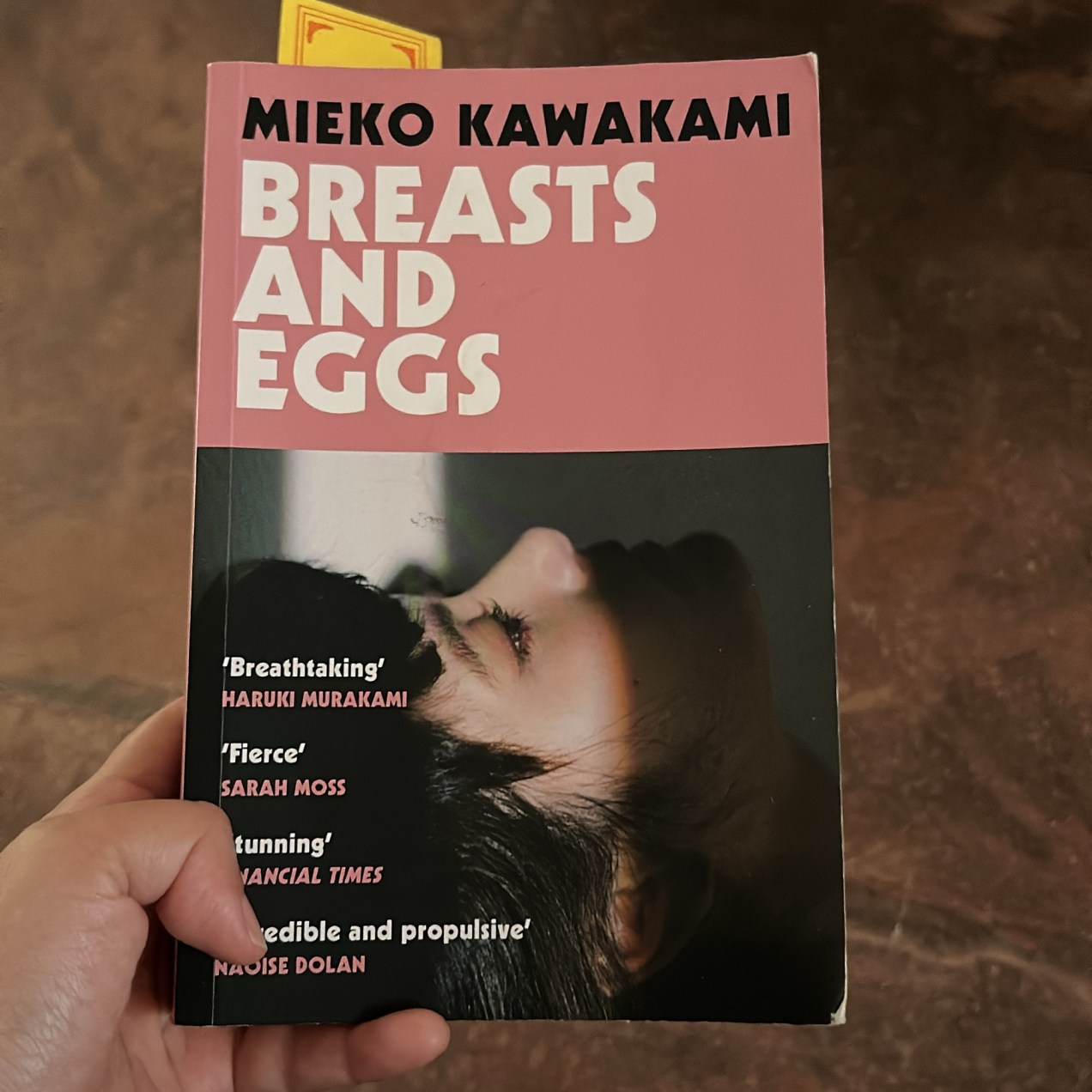
I’m still reading “Breast and Eggs” by Mieko Kawakami. It’s about a writer—Natsuko—who lives alone in a flat in Tokyo. The summary at the back doesn’t say that. It talks about how she and her sister and her daughter experience life as women in Japan. It’s more than that. She lives in this flat alone and then goes out into the world and meets people and thinks about them. People come and go but her flat remains the same. That’s not true. She has to move out of her old flat and into a new one, but it still feels the same to me. She always takes comfort by pushing her head deep into her beanbag.
Reading this book inspired me to visualize my flat. It’ll have a bathroom the same as the one in Badi Momani’s room in Ahmed Lodge, with its stone-carved screen separator where I can get back massages to heal my spine. The living room will be bare except for bookshelves and mats that turn into a mattress when put together. This is where I’ll sleep. And then, right next to it will be the kitchen and dining room. I’ll paint the kitchen walls frog-green and the chairs will have deep red cushions. The floor will be checkered with black and white blocks reminiscent of architecture from the 70s. Of course, I’ll have lots of cats.
But, I want to get back to “Breast and Eggs” and Japanese women living alone in tiny apartments in Tokyo, and writing. I wish I had some statistics to give you: like these are the number of Japanese women who live in tiny apartments in Tokyo, out of which these many are happy or these many have cats or these many are writers. I don’t have these numbers but I’m sure there’s a correlation between one or more of these facts.
In the book, the narrator becomes obsessed with becoming a mother through sperm donation and researches it tirelessly about it. These were the most boring bits of the book. I feel that she does want to become a mother but is afraid and so keeps on researching about it without taking any action. I think the strongest part of the book is when she is with her sister and niece at the beginning of the book.
I also think that Kawakami does dialogue beautifully. Just puts paragraphs of dialogue in the middle of things; stories that we could have just as well read in third person, but they come alive as a character speaks them.
I’m really living in this book right now.
My cat has come out of her box. I’m going for a short walk and then I’ll give her some food.
Before I go here’s a scene : Think of one of those lo-fi channels on YouTube, and think of Natsuko sitting in her flat, on her beanbag, her laptop open and a coffee resting on the floor. Her flat is full of books and her window overlooks the city. It’s dark, probably late into the night and she is reading—not about sperm donation—but about the history of the Yakuza, because her book is about it, and specifically she is reading about them in Osaka, which is where she is from. Outside, the night is clear and the stars are shining. It’ll be tomorrow soon, but Natsuko has time-travelled back to an old-world Osaka, where things feels familiar yet different. Let’s leave her there for now.
 Meher Ali